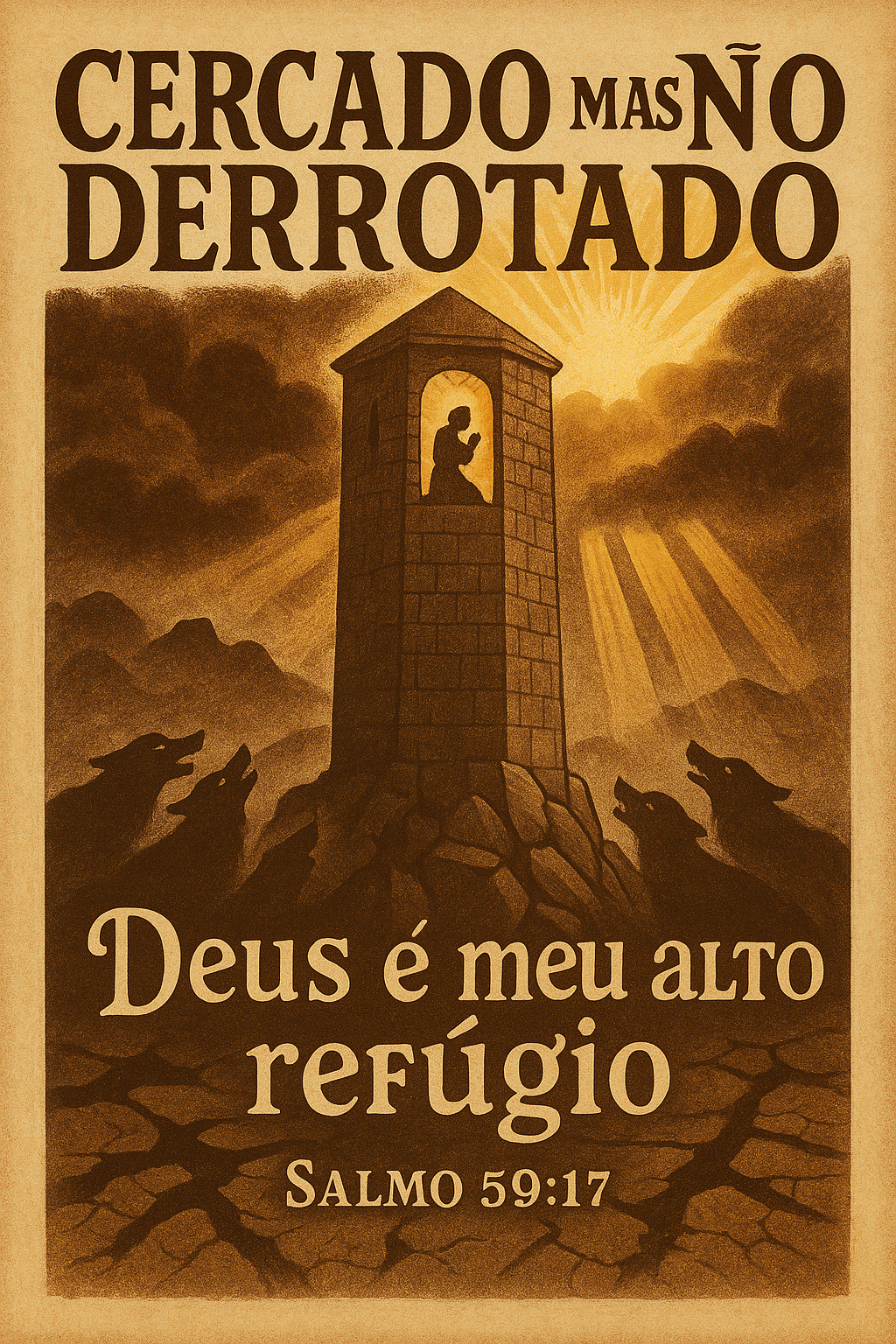
🌙 THE LONGEST NIGHT
Have you ever spent a sleepless night? Not because of common insomnia, but because something — or someone — was threatening your peace, your family, your future?
Imagine David on that terrible night. Outside his house, Saul's armed men stand guard. The order is clear: "When he comes out in the morning, kill him" (1 Samuel 19:11). Michal, his wife, whispers urgently: "If you don't flee tonight, tomorrow you will be killed."
It's in this suffocating pressure, with assassins literally surrounding his house, that David writes Psalm 59. This isn't theory — it's a desperate prayer from someone who knows only a miracle will save him.
🚫 WHEN THERE'S NO HUMAN WAY OUT
"Deliver me from my enemies, O my God; protect me from those who rise up against me!" (v.1)
David isn't facing distant enemies. These are professional soldiers posted at his door. There's no army to call, no place to run, no military strategy that works. It's David against Goliath, but this time Goliath brought a battalion.
💡 Linguistic Insight: The Hebrew word for "deliver me" in v.1 is נַצְּלֵנִי (natzleni), meaning "snatch me away as one removes something from a predator's claws." David feels like helpless prey in the jaws of wild beasts.
Verse 3 reveals the injustice: "For behold, they lie in wait for my life; fierce men stir up strife against me. For no transgression or sin of mine, O Lord!"
🐕 HUNGRY DOGS IN THE DARKNESS
"They return at evening, howl like dogs, and prowl about the city." (v.6)
Why this image is so powerful:
-
Stray dogs were a real threat in the ancient Middle East
- They ran in packs, attacked at night
- Represented constant and unpredictable danger
-
The repetition in vv. 6 and 14 shows the persistence of the threat
- The enemies don't give up easily
- They "prowl," waiting for the right moment to attack
-
"Howl" suggests savagery and lack of reason
- They're not civilized adversaries, but brutal predators
- There's no way to negotiate or reason with this threat
Verse 7: "Behold, they belch out with their mouth; swords are in their lips, for 'Who,' they think, 'will hear us?'"
They speak as if God were deaf. Big mistake.
😂 THE LAUGHTER OF THE ALMIGHTY
"But you, O Lord, laugh at them; you hold all the nations in derision." (v.8)
Why does God laugh?
It's not cruel laughter, but laughter of absolute superiority. It's like a father watching a 3-year-old child "threatening" to beat him up. The disproportion is so absurd that laughter is the only response.
Three truths in this divine laughter:
-
God is not nervous or worried
- He has total control of the situation
- The enemies are no real threat to His plans
-
He sees the comical arrogance of mortals
- They think they're powerful, but they're dust
- They plot as if God didn't exist
-
His sovereignty is absolute
- No human conspiracy threatens His throne
- He allows their plans only to demonstrate His power later
Practical application: When your enemies seem powerful, remember that God sees them as children playing grown-up. He's not threatened. Neither should you be.
🏔️ HIGH REFUGE
"O my Strength, I will watch for you, for you, O God, are my fortress." (v.9)
The Hebrew word for "fortress" here is מִשְׂגָּב (misgav) — literally a "high place," an elevated refuge where predators cannot reach.
In ancient warfare:
- Fortresses were built on high places
- Offered strategic advantage and protection
- Allowed seeing enemies from afar
- Were practically impregnable
Verse 17 repeats the concept: "O my Strength, I will sing praises to you, for you, O God, are my fortress, the God who shows me steadfast love."
Notice: David doesn't ask God to send him to a physical fortress. He declares that God Himself IS the fortress. The security isn't in a place, but in a Person.
🎯 FOUR PRACTICAL STEPS FOR WHEN YOU ARE SURROUNDED
📢 1. CRY OUT to God with total honesty
Verse 1: "Deliver me from my enemies, O my God; protect me from those who rise up against me!"
David doesn't make small talk with God. He screams for help. No religious formalism, no elaborate theology — just raw desperation.
Application: God prefers honest cries to polished prayers. Stop trying to impress God with your faith. He already knows you're terrified.
⏰ 2. WAIT for God actively
Verse 9: "O my Strength, I will watch for you."
The Hebrew word for "watch" (אֲשַׁמְּרָה - ashammerah) suggests active vigilance, like a guard on duty.
How to practice:
- In anxious moments: Remember God is your Strength
- When enemies attack: Remember God laughs at their arrogance
- When there's no human way out: Expect divine intervention
🎵 3. SING before victory appears
Verse 16: "But I will sing of your strength; I will sing aloud of your steadfast love in the morning."
Notice: David sings before being delivered. This is prophetic faith.
How to apply:
- Thank God for the victory you haven't seen yet
- Praise His faithfulness based on His character, not circumstances
- Declare out loud: "My God is greater than this situation"
Verse 11: "Kill them not, lest my people forget; make them totter by your power and bring them down, O Lord, our shield!"
David asks for something surprising: that God not destroy the enemies immediately, but publicly humiliate them so everyone sees that God rules.
Practical application:
- Don't seek personal revenge — let God do justice
- Pray that God be glorified through your situation
- Trust that God can transform persecutors into witnesses of His power
🧠 REFLECTION FOR THE WEEK
- Question to meditate on: "In what area of my life do I need to stop trying to 'break through the siege' with my own strength and trust that God has a way out I haven't imagined?"
- Verse to memorize: "O my Strength, I will sing praises to you, for you, O God, are my fortress, the God who shows me steadfast love." (Psalm 59:17)
- Practical challenge: Identify a situation where you feel "surrounded" and practice prophetic praise — thank God for the victory before you see it happen.
